
Ask your distributor for current extended production schedule.
If you’ve ever watched a match and wondered why wrestling singlets seem so revealing, you’re not the only person to think of it. The sleek, body-contouring design isn’t just for looks; it’s a product of tradition, safety, and pure performance. By staying close to the body, singlets reduce grabbing points, help officials see holds clearly, and let athletes move with uncompromised power and control.
In this article, we’ll explain why wrestling singlets look and fit the way they do. We’ll show how form-fitting cuts, 4-way stretch polyester/spandex, and sport rules work together to create the classic look and keep gear from shifting. We’ll also cover the basics: better movement, clearer calls from officials, long-lasting wear, and all-match comfort.
Skip the compliance guesswork and outfit your entire team by exploring our custom, rule-approved Wrestling Uniforms today.
ORDER NOW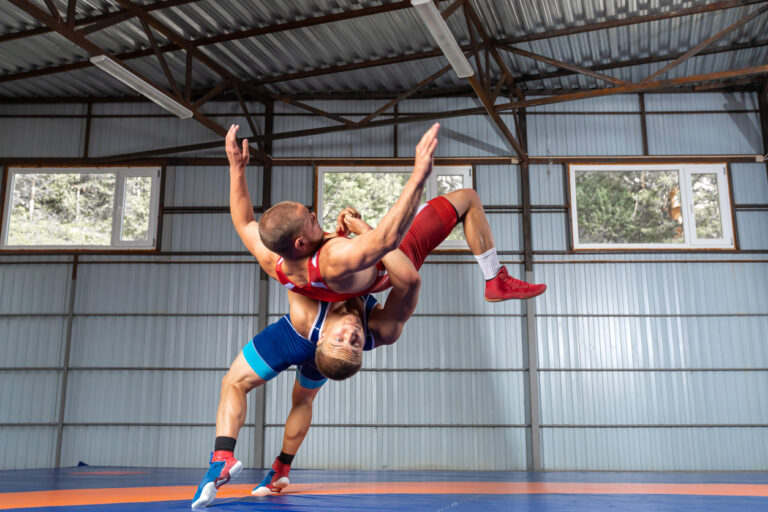
The unique fit is crucial to the sport’s safety, fairness, and performance. Let’s learn the many reasons why this close-to-the-body uniform is the go-to choice for most wrestlers:
Wrestling singlets may look simple, but they’re more than style and fit. To keep the sport fair, safe, and consistent, governing bodies set detailed rules for how a singlet should look and perform. Coaches, athletes, and managers should know these standards to ensure gear passes inspection every match.
Below are the different ways to keep your singlet compliant and competition-ready:
Identify which rules apply to your team or event, such as NFHS for high school wrestling, NCAA for college wrestling, or UWW for international wrestling competitions. Download the latest rule changes before the season, since uniform standards (like cut, coverage, and markings) can shift year to year. Keep a copy on hand for coaches, captains, and your uniform vendor.
Make sure you’re using an allowed style, whether it’s a traditional one-piece singlet or a sanctioned two-piece uniform if your league permits it. Many rule sets now require a higher-cut singlet that provides more torso coverage and prohibit older low-cut styles. Verify strap width, neckline, and leg coverage against your rulebook illustrations or language.
Most rule sets require that the singlet adequately covers the buttocks, chest, and sides and is not see-through. Choose a high-quality, opaque 4-way stretch polyester/spandex fabric that stays non-transparent even when stretched and under bright lights. If needed, use lined panels in sensitive areas to ensure full coverage throughout a match.
Uniform graphics are often restricted by size and placement, and many leagues limit branding to one small manufacturer’s mark plus approved school or club insignia and a small national flag patch. Avoid additional sponsor logos or oversized graphics that can draw penalties. Confirm any color rules your league uses and keep team sets consistent.
If your league allows base layers under the singlet, they typically must be tight-fitting, in permitted solid colors, and within logo-size limits. Depending on the rule set, tights or knee-length compression shorts may be allowed or restricted. Always check the exact language before you buy base layers, and keep a few compliant spares in your team bag.
Most rulebooks forbid hard or abrasive elements like zippers, snaps, and exposed fasteners. Stick to flat seams, soft gripper hems, and smooth finishes that won’t scratch opponents or catch on the mat. No pockets or drawstrings, and nothing that could be considered dangerous or provide an unfair advantage.
Share detailed design mockups with your athletic director, head coach, or assignor before production. Ask your vendor’s design team to map out logo sizes, placements, and coverage lines based on your governing body’s specs. Save the final approvals so you have documentation if questions come up at weigh-ins or check-ins.
Before your first event, run a quick uniform inspection with your captains or equipment manager. Look for coverage issues, non-compliant graphics, worn or torn areas, and any transparency under bright lights. Bring at least one spare singlet to every competition to avoid last-minute disqualifications.
Follow care instructions so the fabric stays opaque, colorfast, and in good condition. Repair or replace any singlet with torn seams, stretched straps, or thinning fabric. If rules are updated mid-season, review them and adjust quickly. Work with a vendor that offers fast reorders and expert guidance to keep your team competition-ready.
The right fabric is everything for a wrestling singlet. The top choices are polyester and high-gauge spandex blends. Both deliver a secure fit, true 4-way stretch, moisture-wicking, and long-lasting wear; the high-gauge option adds extra coverage and support.
Here is why these two lead the pack:
This is the gold standard for modern wrestling singlets and the only fabric blend Full-Gorilla Apparel uses. True 4-way stretch delivers snap-back recovery for a secure, stay-put fit during shots and scrambles. Polyester wicks sweat to keep athletes cool and dry, while spandex adds controlled compression for mobility without ride-up. The fabric resists pilling, handles mat abrasion, maintains opacity under tension, and is ideal for high-definition sublimation.
A denser, finer-knit construction boosts coverage, durability, and stretch recovery. In a singlet, this means excellent opacity, even in lighter colors, plus a smooth, supportive feel that contours without restricting movement. The tighter knit helps the garment hold its shape through repeated wear and washing, resists snagging, and keeps graphics crisp. You still get 4-way stretch, moisture management, and cooling comfort, with added stability.
Generally, you should not alter a wrestling singlet. Most rules, including NFHS, NCAA, and UWW, require the original cut, coverage, and markings. Changes like hemming, taking in, adding panels, or attaching hardware can affect the silhouette or opacity and make it illegal. Altering can also weaken fabric and seams, leading to twisting, ride-up, or transparency, and risking penalties.
Limit work to repairs that restore the singlet to its original condition, preferably through the manufacturer or vendor, to keep stitching and materials compliant. If the fit is wrong, you can reorder the correct size and use league-approved base layers when allowed. Full-Gorilla Apparel can verify compliance, turn reorders quickly, and backs gear with a two-year unconditional construction warranty.
Outfit your wrestling team with custom singlets that perform excellently, fit right, and meet regulations. Full-Gorilla Apparel pairs free pro design services with 4-way stretch polyester/spandex that wicks sweat, resists pilling, and stays opaque under pressure, all backed by a two-year unconditional construction warranty. You’ll get a clear 21 to 28-day production timeline, so expect your singlets to arrive at a moment’s notice.
Contact us so you can talk with our specialists, review design options, and lock in your delivery window.