Ask your distributor for current extended production schedule.
When outfitting your 7 on 7 football team, one of the first decisions you’ll face is choosing between reversible and traditional jerseys. Both options offer distinct advantages for the fast-paced, non-contact format of 7v7 football, but the right choice depends on your team’s budget, tournament schedule, and performance needs.
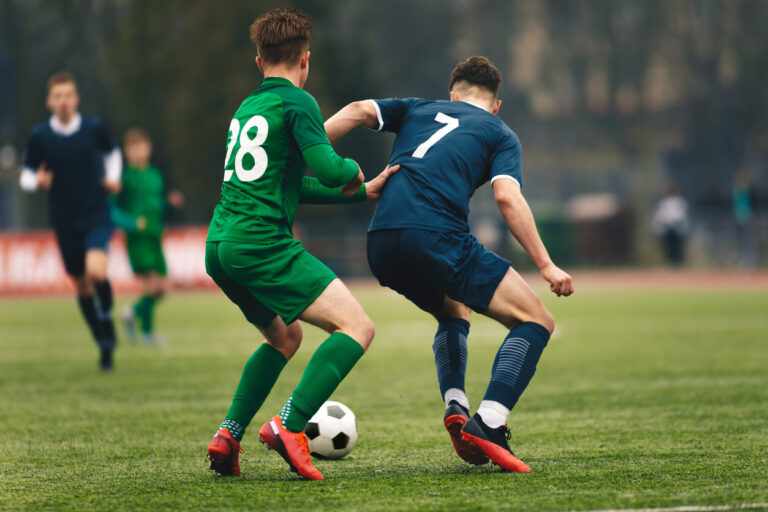
7 on 7 football emphasizes speed, agility, and passing skills without the physical contact of tackle football. Because of this, 7v7 jerseys prioritize lightweight, breathable materials over heavy padding and reinforced stitching. Most teams opt for compression-fit or fitted jerseys made from moisture-wicking fabrics that keep players cool during quick-tempo games.
Unlike tackle football uniforms that require shoulder pad compatibility, 7 on 7 football jerseys can focus entirely on mobility and comfort. This opens up design possibilities that wouldn’t work in traditional tackle football, including the increasingly popular reversible jersey.
Reversible 7 on 7 football jerseys feature two usable sides, typically one light and one dark color. Players can flip the jersey inside out to switch between the two colorways, giving teams built-in home and away uniforms in a single garment.
Cost Efficiency: The most compelling benefit is financial. Instead of ordering separate home and away uniforms, your team invests in one reversible set. For youth programs and club teams operating on tight budgets, this can cut uniform costs nearly in half.
Tournament Flexibility: 7v7 tournaments often feature multiple games in a single day against different opponents. Reversible jerseys let teams quickly adapt to color conflicts without carrying extra uniforms. This convenience becomes invaluable during multi-day events where laundry access is limited.
Simplified Logistics: Coaches and team managers appreciate having one less uniform set to track. Fewer jerseys mean less inventory to order, distribute, collect, and store between seasons.
Traditional jerseys follow the standard athletic uniform model: single-sided construction with full customization options. These jerseys come in endless style variations, from sleeveless compression tops to short-sleeve moisture-wicking tees.
Maximum Customization: Traditional jerseys support unlimited design complexity. Teams can incorporate detailed graphics, photographic elements, gradient patterns, and multi-color logos that would be impossible on reversible jerseys. For programs prioritizing unique team identity and visual impact, traditional jerseys deliver.
Performance-Specific Fits: Traditional construction allows for true compression fits, anatomical seaming, and performance features like ventilation panels. Elite-level teams and older athletes often prefer these technical advantages.
Separate Identity for Home and Away: Some teams value having distinct home and away uniform designs rather than simple color inversions. Traditional jerseys let you create two completely different looks that each stand on their own.
Higher Cost: Ordering separate home and away traditional jerseys roughly doubles your uniform budget compared to reversibles. For well-funded programs this isn’t an issue, but youth leagues and new club teams may find the expense prohibitive.
More to Manage: Maintaining two complete uniform sets means more items to launder, inventory, and replace when players outgrow sizes or jerseys get damaged.
The reversible versus traditional decision comes down to your program’s priorities and resources.
Choose reversible jerseys if:
Choose traditional jerseys if:
Regardless of which jersey type you select, fabric quality and construction should be non-negotiable. Look for jerseys made from moisture-wicking, breathable materials designed for high-performance athletics. Full-dye sublimation printing ensures colors won’t crack, peel, or fade, critical for jerseys that will see heavy use across an entire season.
At Full-Gorilla Apparel, all custom team uniforms are crafted with high-quality fabrics and durable construction. Whether you choose reversible or traditional 7 on 7 football jerseys, you get the same two-year unconditional construction warranty, guaranteed production timeline, and lifetime replacement availability with no minimums.
Some programs split the difference by ordering reversible jerseys for practice and local games, then investing in premium traditional uniforms for championship tournaments and showcase events. This approach balances budget consciousness with the desire to make a strong visual impression when it matters most.
Others rotate between reversible and traditional jerseys across seasons, using reversibles for younger age groups while graduating older teams into traditional uniforms as their skill level and commitment increases.
There’s no universally “better” choice between reversible and traditional 7 on 7 football jerseys. The right decision depends on your team’s specific circumstances, preferences, and goals. Reversible jerseys excel at providing budget-friendly versatility and tournament convenience. Traditional jerseys offer unlimited customization and distinct team identity.
What matters most is choosing jerseys that fit your players well, perform reliably through an entire season, and represent your team with pride. Focus on quality construction and performance fabrics first, then let your budget and design preferences guide the reversible versus traditional decision.
Ready to outfit your 7v7 team with custom jerseys built for performance? Contact Full-Gorilla Apparel to explore your options and get started on a design that fits your team perfectly.